Search results for “Formation of Moon”

Why Can't We Live On The Moon?

We could try living on the moon ... but it might not be a good idea. Click here to see more videos: https://alugha.com/LifeNoggin Follow Life Noggin! Facebook: https://www.facebook.com/LifeNoggin/?ref=br_rs Instagram: https://instagram.com/lifenoggin/ Twitter: https://twitter.com/lifenoggin Offi
Evolution of the Moon

Learn about the evolution of Earth's moon, from its initial formation to its current state, in this video from NASA. Real satellite imagery, as well as simulations, explore how the Moon has changed over time. The video looks at how the Moon likely formed about 4.5 billion years ago, how impacts from

Why Doesn't the Moon Fall Down?

Astronomer Doris Daou explains how the forces of speed and gravity keep the Moon in a constant orbit around Earth in this animated video segment adapted from NASA. The Moon, Earth's natural satellite, seems to hover in the sky, unaffected by gravity. However, the reason the Moon stays in orbit is pr

Tour of the Moon | NASA Planetary Sciences

Take a tour of the Moon's surface features in this video from NASA. Images and topographic maps show craters, rocks, mountains, basins, and valleys, including the Orientale basin, Shackleton crater, South Pole-Aitken basin, Tycho crater, Aristarchus plateau, Mare Serenitatis, Compton-Belkovich volca

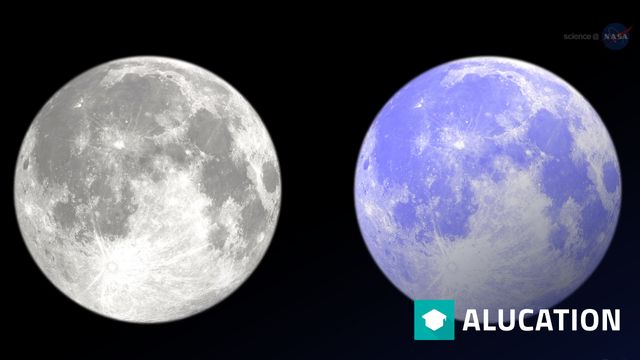
ScienceCasts: Summer Blue Moon

The second full Moon of July is just around the corner. According to modern folklore, it is a "Blue Moon." Visit http://science.nasa.gov/ for more. Click here to see more videos: https://alugha.com/NASA This video is from 2015

Investigating the Moon's Interior | NASA Planetary Sciences

Discover how scientists plan to use data from the GRAIL mission and a map of the Moon's gravitational field to learn about its internal structure. By comparing data about the Moon's gravity with information about its topography, scientists can gain a better understanding of the Moon's formation and

ScienceCasts: Amazing Moons

When the Space Age began, explorers were eager to visit the planets of the solar system. As the years have passed, however, astronomers have realized that the moons of the solar system may be even more interesting. Visit http://science.nasa.gov/ for more. Click here to see more videos: https://alu

08 Ion formation

Rutherford's atomic model can already explain a simple formation of charged particles (ions). The PSE can help us detect whether an atom absorbs or releases electrons. Original: "Wolfgang Dukorn" Original: German. All translations in this video have been done by the alugha AI.

The Formation of Stars | NASA Planetary Sciences

Discover how the James Webb Space Telescope will help us better understand solar system formation in this video from NASA. Images from the Hubble Space Telescope show star-forming regions within the Eagle nebula: visible light images show vast clouds of gas and dust, and infrared images provide a gl

Saturn's Rings and Moons | NASA Planetary Sciences

Explore the rings and moons of Saturn through images from the Cassini spacecraft. Saturn's rings were discovered in 1610 by Galileo Galilei, although he did not see enough detail to know what they were. In 2004, the Cassini spacecraft began capturing unprecedented images of Saturn's atmosphere and t

The formation of the Alps

The Alps are Central Europe's highest mountains, towering as high as 4800 meters. Today, mainly the harsh weather shapes the Alps. But the forces that formed these mountains came from within the Earth. Author: ZDF/Terra X/Bilderfest/Florian Breier, Christian Stiefenhofer/Michi Kern/Klaus Wache/Tob