Search results for “Kepler”

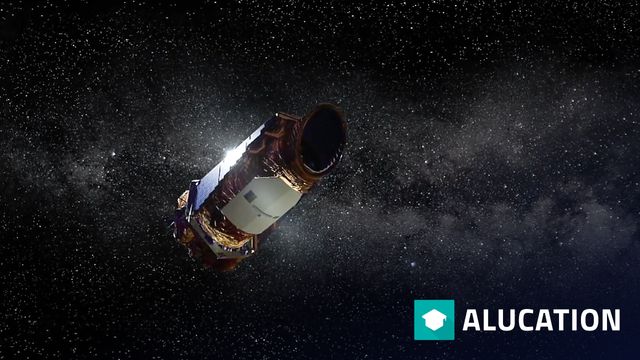
ScienceCasts: In Search of Earth... 2.0

Astronomers have long hoped to find another planet in the cosmos similar to Earth--a blue dot in the distance that could harbor life akin to our own. NASA's Kepler spacecraft may have found the next best thing. Visit http://science.nasa.gov/ for more. Click here to see more videos: https://alugha.

Why Doesn't the Moon Fall Down?

Astronomer Doris Daou explains how the forces of speed and gravity keep the Moon in a constant orbit around Earth in this animated video segment adapted from NASA. The Moon, Earth's natural satellite, seems to hover in the sky, unaffected by gravity. However, the reason the Moon stays in orbit is pr

Lunar Eclipse Essentials | NASA Planetary Sciences

Discover what happens during a lunar eclipse in this video from NASA. The orbit of the Moon around Earth causes the monthly phases of the Moon; lunar eclipses occur when the Moon passes through Earth's shadow. The video shows how the appearance of the Moon changes as it passes through Earth's penumb

Mapping the Moon's Gravity | NASA Planetary Sciences

Launched in September 2011, find out about the Gravity Recovery and Interior Laboratory (GRAIL) mission to measure the gravitational field of the Moon and study how the Moon developed over time. Animations illustrate technical aspects of the mission's design, including the launch, orbital insertion

Investigating the Moon's Interior | NASA Planetary Sciences

Discover how scientists plan to use data from the GRAIL mission and a map of the Moon's gravitational field to learn about its internal structure. By comparing data about the Moon's gravity with information about its topography, scientists can gain a better understanding of the Moon's formation and

How Would You Turn a Bolt in Space?

Tools such as saws, hammers, and levers are designed to make work easier. Sometimes, the environment in which a person works dictates whether or not a certain tool will get the job done. In the microgravity environment of space, astronauts are often required to do experiments or simple repairs. On E

What's Unusual About Mercury? | NASA Planetary Sciences

Discover why Mercury has a tail like a comet, and why its poles are covered in ice despite its close proximity to the Sun. Mercury, the closest planet to the Sun, rotates three times on its axis every two of its years. Despite having temperatures that are hot enough to melt lead, the tilt of the pla

The Evolution of the Kuiper Belt | NASA Planetary Sciences

Learn about Neptune's gravitational effect on dust contained in the Kuiper belt and discover how it could help astronomers look for planets around other stars. This video from NASA explores the idea that if would-be alien astronomers were looking for planets around the Sun, they could potentially de